Understanding the science behind zone refining and how the distribution coefficient determines purification effectiveness.
During zone refining or zone melting, short molten zones move slowly through an elongated sample of crystalline material. A molten zone traversing a solid sample has two liquid-solid interfaces: a melting interface and a freezing interface.
At the melting interface, the sample is merely melted and mixed with the contents of the molten zone. At the freezing interface, the crystals tend to be higher in purity than the liquid phase.

Extraordinarily high purification of chemicals can be obtained by repeatedly passing the molten zone or zones through the sample.
The impurities are concentrated at the end of the sample, generally in the direction of the movement of the molten zone. This allows for separation of the pure material from the impurity-rich fraction.
The separation of impurities can be expressed mathematically as a constant, K, known as the distribution coefficient
Distribution coefficient - determines impurity behavior
Concentration of impurity in the solid (crystalline) phase
Concentration of impurity in the liquid phase
If K is less than 1 (the usual case), the impurities will follow the movement of the liquid zone. This is the most common scenario and results in impurities being swept to one end of the sample tube, leaving the purified material at the opposite end.
If K is greater than 1, the impurities will travel in the opposing direction. While less common, this can be utilized for specific purification applications where the impurity has a higher affinity for the solid phase.
The distribution coefficient determines how effectively impurities can be separated from the desired compound. For most organic materials, K is less than 1, meaning that with each pass of the molten zone, impurities are progressively concentrated at one end of the sample.
By using multiple zones simultaneously (four in the MiniZone II), the purification process is accelerated, allowing for significant purification in a single overnight run of 18 hours.
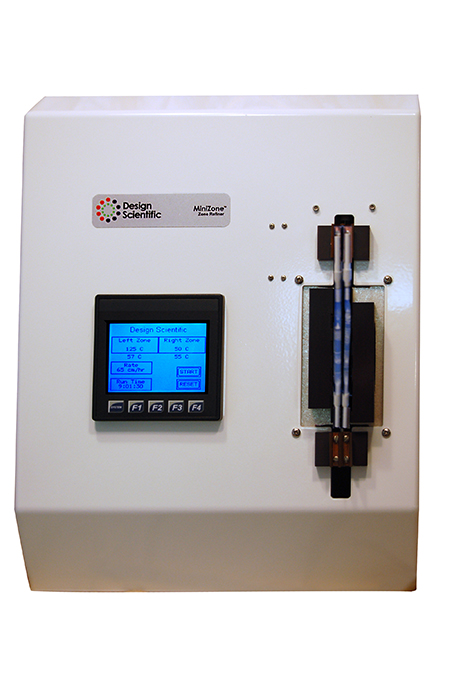
Contact us to learn how the MiniZone II can achieve exceptional purity for your materials.
Contact Us